Temperature Models Example#
This example demonstrates how to use models with temperature as a feature in the Routee Powertrain library.
import routee.powertrain as pt
import pandas as pd
import matplotlib.pyplot as plt
To demonstrate the use of temperature models, we will load a standard Tesla Model 3 RWD model (without temperature as a feature) and two temperature models (steady-state and transient) for the same vehicle. We will then predict energy consumption over a sample route at different ambient temperatures (72°F and 32°F) and compare the results.
It's important to understand the distinction between steady-state and transient temperature models:
Steady-State Temperature Models: These models assume that the vehicle's thermal conditions have stabilized to a constant state. They are typically used for longer trips where the vehicle has had sufficient time for the control systems to have stabilized the thermal environment. In this example, we will use the steady-state model for the portion of the trip after the first 5 minutes at 32°F.
Transient Temperature Models: These models account for the period when the vehicle is still adjusting to the ambient temperature. For example, when a vehicle starts a trip in cold weather and has been sitting outside, it takes some time for the battery and cabin to warm up.
tesla = pt.load_model("tesla/model_3_bev/2022/rf_base_fe510e40/v1")
tesla_with_temp_steady = pt.load_model(
    "tesla/model_3_bev/2022/rf_steady_thermal_ab1db342/v1"
)
tesla_with_temp_transient = pt.load_model(
    "tesla/model_3_bev/2022/rf_transient_thermal_ab1db342/v1"
)
/opt/hostedtoolcache/Python/3.10.21/x64/lib/python3.10/site-packages/tqdm/auto.py:21: TqdmWarning: IProgress not found. Please update jupyter and ipywidgets. See https://ipywidgets.readthedocs.io/en/stable/user_install.html
  from .autonotebook import tqdm as notebook_tqdm
Load a sample route and prepare it for prediction.
sample_route = pt.load_sample_route()
sample_route["time_minutes"] = (
    sample_route["distance"] / sample_route["speed_mph"]
) * 60
sample_route["cummulative_time_minutes"] = sample_route["time_minutes"].cumsum()
sample_route["cummulative_distance"] = sample_route["distance"].cumsum()
Set the ambient temperature for the route.
sample_route_72F = sample_route.copy()
sample_route_72F["ambient_temp_f"] = 72

sample_route_32F = sample_route.copy()
sample_route_32F["ambient_temp_f"] = 32
For the 32°F route, we will use the transient model for the first 5 minutes and the steady-state model for the remainder of the trip.
sample_route_32F_transient = sample_route_32F[
    sample_route_32F["cummulative_time_minutes"] <= 5
]
sample_route_32F_steady = sample_route_32F[
    sample_route_32F["cummulative_time_minutes"] > 5
]
Predict energy consumption using the different models and ambient temperatures. Each model uses its own configured feature set, so we just need to make sure the input DataFrame contains the columns the model expects.
# The base configs label grade and distance differently from the thermal
# configs, and emit "electric_kwh" rather than "kwh".
sample_route_base = sample_route.rename(
    columns={"grade_percent": "grade_pct", "distance": "distance_mi"}
)
energy = tesla.predict(sample_route_base).rename(columns={"electric_kwh": "kwh"})
energy_with_temp_72F = tesla_with_temp_steady.predict(sample_route_72F)
energy_with_temp_32F_transient = tesla_with_temp_transient.predict(
    sample_route_32F_transient
)
energy_with_temp_32F_steady = tesla_with_temp_steady.predict(sample_route_32F_steady)
energy_with_temp_32F = pd.concat(
    [energy_with_temp_32F_transient, energy_with_temp_32F_steady]
)
/opt/hostedtoolcache/Python/3.10.21/x64/lib/python3.10/site-packages/routee/powertrain/validation/physics.py:1088: UserWarning: '2022_Tesla_Model_3_RWD_0F_110F_steady trained July 2025' has no vehicle mass (mass_lbs), so its physical energy bounds cannot be computed and the output guardrail will not be applied to its predictions. Set mass_lbs on the model config to enable the guardrail.
  warnings.warn(
/opt/hostedtoolcache/Python/3.10.21/x64/lib/python3.10/site-packages/routee/powertrain/validation/physics.py:1088: UserWarning: '2022_Tesla_Model_3_RWD_0F_110F_transient trained July 2025' has no vehicle mass (mass_lbs), so its physical energy bounds cannot be computed and the output guardrail will not be applied to its predictions. Set mass_lbs on the model config to enable the guardrail.
  warnings.warn(
/opt/hostedtoolcache/Python/3.10.21/x64/lib/python3.10/site-packages/routee/powertrain/validation/physics.py:1088: UserWarning: '2022_Tesla_Model_3_RWD_0F_110F_steady trained July 2025' has no vehicle mass (mass_lbs), so its physical energy bounds cannot be computed and the output guardrail will not be applied to its predictions. Set mass_lbs on the model config to enable the guardrail.
  warnings.warn(
Now, we can compare the energy consumption results.
energy["cummulative_energy_kwh"] = energy["kwh"].cumsum()
energy_with_temp_72F["cummulative_energy_kwh"] = energy_with_temp_72F["kwh"].cumsum()
energy_with_temp_32F["cummulative_energy_kwh"] = energy_with_temp_32F["kwh"].cumsum()
plt.plot(
    sample_route["cummulative_distance"],
    energy["cummulative_energy_kwh"],
    label="Tesla without Temperature",
)
plt.plot(
    sample_route["cummulative_distance"],
    energy_with_temp_72F["cummulative_energy_kwh"],
    label="Tesla with Temperature 72F",
)
plt.plot(
    sample_route["cummulative_distance"],
    energy_with_temp_32F["cummulative_energy_kwh"],
    label="Tesla with Temperature 32F",
)
plt.xlabel("Cumulative Distance (miles)")
plt.ylabel("Cumulative Energy (kWh)")
plt.legend()
<matplotlib.legend.Legend at 0x7f82080dc040>
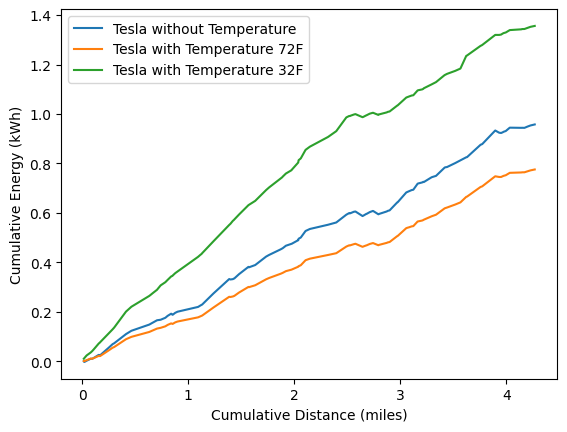
Notice how the energy consumption for the 32°F route is higher than the other two scenarios, reflecting the increased energy demand in colder temperatures.
Something else to note is that the model that doesn't consider temperature explicitly includes a "real world correction factor" to account for things like temperature on average. This explains why the energy consumption for the 72°F route is slightly lower than the other two scenarios since the model without temperature adjustment is effectively averaging out the impact of temperature. The 72°F condition would be considered the "ideal" case since the vehicle does not have to expand any extra effort to maintain the cabin temperature.
Multi-Vehicle Comparison#
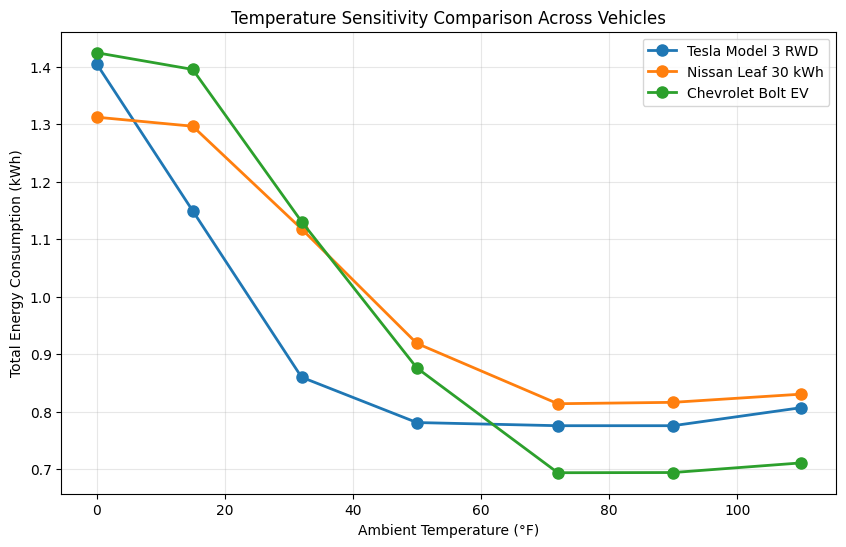
Now let's compare the Tesla Model 3 with other electric vehicles to see how different EVs perform under various temperature conditions. We'll load the Nissan Leaf and Chevrolet Bolt models and compare their energy consumption across different temperatures.
nissan_leaf_steady = pt.load_model(
    "nissan/leaf_30_kwh_bev/2016/rf_steady_thermal_ab1db342/v1"
)
nissan_leaf_transient = pt.load_model(
    "nissan/leaf_30_kwh_bev/2016/rf_transient_thermal_ab1db342/v1"
)

chevy_bolt_steady = pt.load_model(
    "chevrolet/bolt_bev/2020/rf_steady_thermal_ab1db342/v1"
)
chevy_bolt_transient = pt.load_model(
    "chevrolet/bolt_bev/2020/rf_transient_thermal_ab1db342/v1"
)
Temperature Sensitivity Comparison#
Let's compare how each vehicle's energy consumption changes across a range of temperatures (0°F, 15°F, 32°F, 50°F, 72°F, 90°F, 110°F). We'll use steady-state models for this comparison.
# Predict energy for all vehicles at different temperatures
temperatures = [0, 15, 32, 50, 72, 90, 110]
vehicles_data = {
    "Tesla Model 3 RWD": tesla_with_temp_steady,
    "Nissan Leaf 30 kWh": nissan_leaf_steady,
    "Chevrolet Bolt EV": chevy_bolt_steady,
}

total_energy_by_temp = {vehicle: [] for vehicle in vehicles_data.keys()}

for temp in temperatures:
    route_temp = sample_route.copy()
    route_temp["ambient_temp_f"] = temp

    for vehicle_name, model in vehicles_data.items():
        energy_pred = model.predict(route_temp)
        total_energy_by_temp[vehicle_name].append(energy_pred["kwh"].sum())

# Create temperature sensitivity comparison plot
plt.figure(figsize=(10, 6))
for vehicle_name, energies in total_energy_by_temp.items():
    plt.plot(
        temperatures,
        energies,
        marker="o",
        linewidth=2,
        markersize=8,
        label=vehicle_name,
    )

plt.xlabel("Ambient Temperature (°F)")
plt.ylabel("Total Energy Consumption (kWh)")
plt.title("Temperature Sensitivity Comparison Across Vehicles")
plt.legend()
plt.grid(True, alpha=0.3)
/opt/hostedtoolcache/Python/3.10.21/x64/lib/python3.10/site-packages/routee/powertrain/validation/physics.py:1088: UserWarning: '2022_Tesla_Model_3_RWD_0F_110F_steady trained July 2025' has no vehicle mass (mass_lbs), so its physical energy bounds cannot be computed and the output guardrail will not be applied to its predictions. Set mass_lbs on the model config to enable the guardrail.
  warnings.warn(
/opt/hostedtoolcache/Python/3.10.21/x64/lib/python3.10/site-packages/routee/powertrain/validation/physics.py:1088: UserWarning: '2016_Nissan_Leaf_30_kWh_0F_110F_steady trained July 2025' has no vehicle mass (mass_lbs), so its physical energy bounds cannot be computed and the output guardrail will not be applied to its predictions. Set mass_lbs on the model config to enable the guardrail.
  warnings.warn(
/opt/hostedtoolcache/Python/3.10.21/x64/lib/python3.10/site-packages/routee/powertrain/validation/physics.py:1088: UserWarning: '2020_Chevrolet_Bolt_EV_0F_110F_steady trained July 2025' has no vehicle mass (mass_lbs), so its physical energy bounds cannot be computed and the output guardrail will not be applied to its predictions. Set mass_lbs on the model config to enable the guardrail.
  warnings.warn(
/opt/hostedtoolcache/Python/3.10.21/x64/lib/python3.10/site-packages/routee/powertrain/validation/physics.py:1088: UserWarning: '2022_Tesla_Model_3_RWD_0F_110F_steady trained July 2025' has no vehicle mass (mass_lbs), so its physical energy bounds cannot be computed and the output guardrail will not be applied to its predictions. Set mass_lbs on the model config to enable the guardrail.
  warnings.warn(
/opt/hostedtoolcache/Python/3.10.21/x64/lib/python3.10/site-packages/routee/powertrain/validation/physics.py:1088: UserWarning: '2016_Nissan_Leaf_30_kWh_0F_110F_steady trained July 2025' has no vehicle mass (mass_lbs), so its physical energy bounds cannot be computed and the output guardrail will not be applied to its predictions. Set mass_lbs on the model config to enable the guardrail.
  warnings.warn(
/opt/hostedtoolcache/Python/3.10.21/x64/lib/python3.10/site-packages/routee/powertrain/validation/physics.py:1088: UserWarning: '2020_Chevrolet_Bolt_EV_0F_110F_steady trained July 2025' has no vehicle mass (mass_lbs), so its physical energy bounds cannot be computed and the output guardrail will not be applied to its predictions. Set mass_lbs on the model config to enable the guardrail.
  warnings.warn(
/opt/hostedtoolcache/Python/3.10.21/x64/lib/python3.10/site-packages/routee/powertrain/validation/physics.py:1088: UserWarning: '2022_Tesla_Model_3_RWD_0F_110F_steady trained July 2025' has no vehicle mass (mass_lbs), so its physical energy bounds cannot be computed and the output guardrail will not be applied to its predictions. Set mass_lbs on the model config to enable the guardrail.
  warnings.warn(
/opt/hostedtoolcache/Python/3.10.21/x64/lib/python3.10/site-packages/routee/powertrain/validation/physics.py:1088: UserWarning: '2016_Nissan_Leaf_30_kWh_0F_110F_steady trained July 2025' has no vehicle mass (mass_lbs), so its physical energy bounds cannot be computed and the output guardrail will not be applied to its predictions. Set mass_lbs on the model config to enable the guardrail.
  warnings.warn(
/opt/hostedtoolcache/Python/3.10.21/x64/lib/python3.10/site-packages/routee/powertrain/validation/physics.py:1088: UserWarning: '2020_Chevrolet_Bolt_EV_0F_110F_steady trained July 2025' has no vehicle mass (mass_lbs), so its physical energy bounds cannot be computed and the output guardrail will not be applied to its predictions. Set mass_lbs on the model config to enable the guardrail.
  warnings.warn(
/opt/hostedtoolcache/Python/3.10.21/x64/lib/python3.10/site-packages/routee/powertrain/validation/physics.py:1088: UserWarning: '2022_Tesla_Model_3_RWD_0F_110F_steady trained July 2025' has no vehicle mass (mass_lbs), so its physical energy bounds cannot be computed and the output guardrail will not be applied to its predictions. Set mass_lbs on the model config to enable the guardrail.
  warnings.warn(
/opt/hostedtoolcache/Python/3.10.21/x64/lib/python3.10/site-packages/routee/powertrain/validation/physics.py:1088: UserWarning: '2016_Nissan_Leaf_30_kWh_0F_110F_steady trained July 2025' has no vehicle mass (mass_lbs), so its physical energy bounds cannot be computed and the output guardrail will not be applied to its predictions. Set mass_lbs on the model config to enable the guardrail.
  warnings.warn(
/opt/hostedtoolcache/Python/3.10.21/x64/lib/python3.10/site-packages/routee/powertrain/validation/physics.py:1088: UserWarning: '2020_Chevrolet_Bolt_EV_0F_110F_steady trained July 2025' has no vehicle mass (mass_lbs), so its physical energy bounds cannot be computed and the output guardrail will not be applied to its predictions. Set mass_lbs on the model config to enable the guardrail.
  warnings.warn(
/opt/hostedtoolcache/Python/3.10.21/x64/lib/python3.10/site-packages/routee/powertrain/validation/physics.py:1088: UserWarning: '2022_Tesla_Model_3_RWD_0F_110F_steady trained July 2025' has no vehicle mass (mass_lbs), so its physical energy bounds cannot be computed and the output guardrail will not be applied to its predictions. Set mass_lbs on the model config to enable the guardrail.
  warnings.warn(
/opt/hostedtoolcache/Python/3.10.21/x64/lib/python3.10/site-packages/routee/powertrain/validation/physics.py:1088: UserWarning: '2016_Nissan_Leaf_30_kWh_0F_110F_steady trained July 2025' has no vehicle mass (mass_lbs), so its physical energy bounds cannot be computed and the output guardrail will not be applied to its predictions. Set mass_lbs on the model config to enable the guardrail.
  warnings.warn(
/opt/hostedtoolcache/Python/3.10.21/x64/lib/python3.10/site-packages/routee/powertrain/validation/physics.py:1088: UserWarning: '2020_Chevrolet_Bolt_EV_0F_110F_steady trained July 2025' has no vehicle mass (mass_lbs), so its physical energy bounds cannot be computed and the output guardrail will not be applied to its predictions. Set mass_lbs on the model config to enable the guardrail.
  warnings.warn(
/opt/hostedtoolcache/Python/3.10.21/x64/lib/python3.10/site-packages/routee/powertrain/validation/physics.py:1088: UserWarning: '2022_Tesla_Model_3_RWD_0F_110F_steady trained July 2025' has no vehicle mass (mass_lbs), so its physical energy bounds cannot be computed and the output guardrail will not be applied to its predictions. Set mass_lbs on the model config to enable the guardrail.
  warnings.warn(
/opt/hostedtoolcache/Python/3.10.21/x64/lib/python3.10/site-packages/routee/powertrain/validation/physics.py:1088: UserWarning: '2016_Nissan_Leaf_30_kWh_0F_110F_steady trained July 2025' has no vehicle mass (mass_lbs), so its physical energy bounds cannot be computed and the output guardrail will not be applied to its predictions. Set mass_lbs on the model config to enable the guardrail.
  warnings.warn(
/opt/hostedtoolcache/Python/3.10.21/x64/lib/python3.10/site-packages/routee/powertrain/validation/physics.py:1088: UserWarning: '2020_Chevrolet_Bolt_EV_0F_110F_steady trained July 2025' has no vehicle mass (mass_lbs), so its physical energy bounds cannot be computed and the output guardrail will not be applied to its predictions. Set mass_lbs on the model config to enable the guardrail.
  warnings.warn(
/opt/hostedtoolcache/Python/3.10.21/x64/lib/python3.10/site-packages/routee/powertrain/validation/physics.py:1088: UserWarning: '2022_Tesla_Model_3_RWD_0F_110F_steady trained July 2025' has no vehicle mass (mass_lbs), so its physical energy bounds cannot be computed and the output guardrail will not be applied to its predictions. Set mass_lbs on the model config to enable the guardrail.
  warnings.warn(
/opt/hostedtoolcache/Python/3.10.21/x64/lib/python3.10/site-packages/routee/powertrain/validation/physics.py:1088: UserWarning: '2016_Nissan_Leaf_30_kWh_0F_110F_steady trained July 2025' has no vehicle mass (mass_lbs), so its physical energy bounds cannot be computed and the output guardrail will not be applied to its predictions. Set mass_lbs on the model config to enable the guardrail.
  warnings.warn(
/opt/hostedtoolcache/Python/3.10.21/x64/lib/python3.10/site-packages/routee/powertrain/validation/physics.py:1088: UserWarning: '2020_Chevrolet_Bolt_EV_0F_110F_steady trained July 2025' has no vehicle mass (mass_lbs), so its physical energy bounds cannot be computed and the output guardrail will not be applied to its predictions. Set mass_lbs on the model config to enable the guardrail.
  warnings.warn(