3. Initial design
Before the optimizer has any results to learn from, it needs a first set of experiments. This page generates that set, queues it so you can record the results, and exports it.
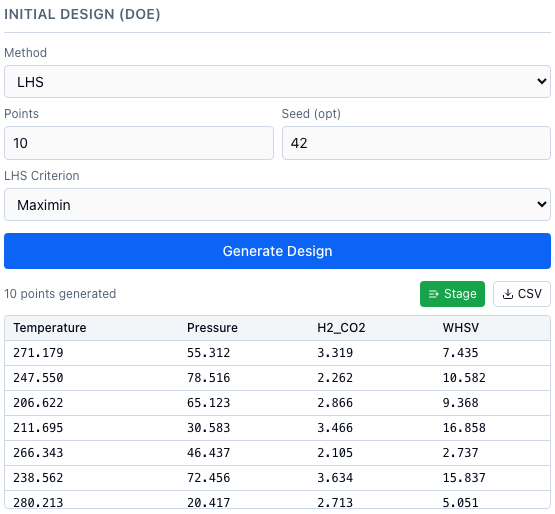
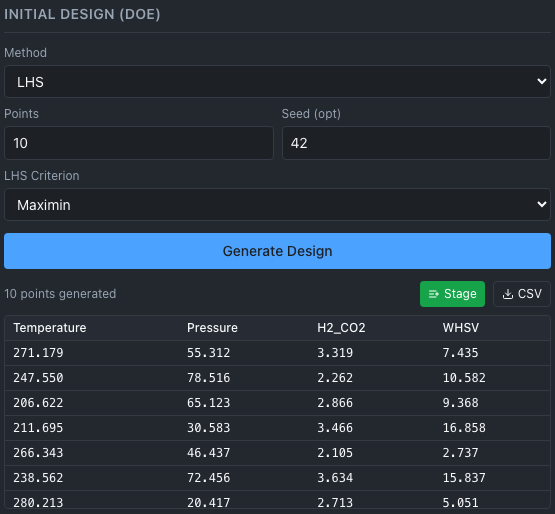
A Latin hypercube design of 10 points with seed 42. Stage queues the points for recording; CSV saves them.
Choose a method
Most sessions start with a space-filling design, which spreads points over the whole space without assuming a model. Classical and screening designs have a fixed structure for fitting a polynomial or finding the variables that matter. The theory is in Design of experiments. The Method menu groups the methods as shown.
| Group | Method menu | method |
You set |
|---|---|---|---|
| Space-Filling | LHS | lhs |
Points, Seed (opt), LHS Criterion |
| Sobol | sobol |
Points, Seed (opt) | |
| Halton | halton |
Points | |
| Hammersly | hammersly |
Points | |
| Random | random |
Points, Seed (opt) | |
| Classical RSM | Full Factorial | full_factorial |
Levels per factor, Center points |
| Fractional Factorial | fractional_factorial |
Generators (opt), Center points | |
| CCD | ccd |
Alpha, Face, Center points | |
| Box-Behnken | box_behnken |
Center points | |
| Screening | Plackett-Burman | plackett_burman |
Center points |
| GSD | gsd |
Levels per factor, Reduction |
For the space-filling methods you choose the number of points. For the others the design decides: with four real variables and the default settings, Full Factorial gives 17 runs, Fractional Factorial 9, CCD 26, Box-Behnken 25, Plackett-Burman 9 and GSD 8. Box-Behnken needs at least three continuous variables. Fractional Factorial, CCD, Box-Behnken and Plackett-Burman do not support categorical variables; the panel warns you and disables Generate Design. Use Full Factorial, GSD or a space-filling method when a variable is categorical.
An optimal design, which targets a model you name, has its own panel: see Optimal design. If a variable is hard to change, a Split-plot toggle appears above Method; see Split-plot designs.
1. Generate a design
- In Initial Design (DoE), pick a Method.
- For a space-filling method, set Points. Seed (opt) is shown for LHS, Sobol and Random; leave it blank and each click draws a new design, or type a whole number to get the same design every time. Halton and Hammersly are fixed sequences and have no seed.
- For LHS, LHS Criterion is Maximin, Correlation or Ratio. For CCD, Alpha is Orthogonal or Rotatable, and Face is Circumscribed, Inscribed or Faced.
- Choose Generate Design. The panel reports "10 points generated" and lists them in a table.
- Choose Stage to queue the points. The Add Point... button in the Experiment Data panel then shows the count, and steps through the staged points so you can enter each result; see Run and record. Choose CSV to save the points as
initial_design_<method>_<N>pts.csv, for exampleinitial_design_lhs_10pts.csv. In Chrome and Edge on https or localhost a save dialog lets you pick the folder; other browsers, and plain http addresses, download the file.
Generating a design does not add anything to the session's data. Stage records each point with a reason such as "Initial DoE (LHS)", and writes the method and its settings to the audit log. Linear input constraints, if you set any, apply to every method; see Constraints.
Defaults
| Setting | Web app | Python and REST |
|---|---|---|
| Method | LHS | method="lhs" |
| Points | 10; the number field steps between 5 and 100 | n_points of None becomes 10 for space-filling methods; REST accepts 1 to 1000 |
| Seed (opt) | blank, shown as Auto | random_seed=None, a new design every call |
| LHS Criterion | Maximin | lhs_criterion="maximin" |
| Center points | 1 | n_center=1; REST accepts 0 to 10 |
| Levels per factor | 2 | n_levels=2; the web menu offers 2 or 3 for Full Factorial and 2 to 5 for GSD |
| Generators (opt) | blank, chosen from the number of variables | generators=None |
| Alpha | Orthogonal | ccd_alpha="orthogonal" |
| Face | Circumscribed | ccd_face="circumscribed" |
| Reduction | ÷2 | gsd_reduction=2; REST accepts 2 to 10 |
Known issue
T9: Circumscribed and Inscribed give the same CCD, and the server log says so when you ask for Circumscribed. The axial points land on the variable bounds and the factorial points sit inside them, for example at 2.6 and 7.4 with four variables on a range of 0 to 10 and the default Orthogonal alpha. Faced puts every point on the bounds or the center.
From Python or REST
from alchemist_core import OptimizationSession

session = OptimizationSession()
session.add_variable("temperature", "real", bounds=(200.0, 300.0), unit="°C")
session.add_variable("pressure", "real", bounds=(20.0, 80.0), unit="bar")
session.add_variable("h2_co2", "real", bounds=(2.0, 4.0))
session.add_variable("whsv", "real", bounds=(1.5, 18.0))

points = session.generate_initial_design("lhs", n_points=10, random_seed=42)
print(len(points))
print(points[0])
Each point is a dictionary of variable values. Run it, then record the result with session.add_experiment(point, output=...). Classical methods take their size from the design:
POST /api/v1/sessions/{session_id}/initial-design
Content-Type: application/json

{"method": "lhs", "n_points": 10, "random_seed": 42, "lhs_criterion": "maximin"}
The response holds points, method, n_points, design_info (for classical designs) and feasibility (when constraints are set). The other request keys are the Python arguments above: n_levels, n_center, generators, ccd_alpha, ccd_face, gsd_reduction and allow_infeasible. Nothing is added to the session's data.
To queue the points as the app's Stage does, post them to the staged-experiments route:
POST /api/v1/sessions/{session_id}/experiments/staged/batch
Content-Type: application/json

{"experiments": [{"temperature": 271.2, "pressure": 55.3, "h2_co2": 3.3, "whsv": 7.4}], "reason": "Initial DoE (LHS)"}
This route is deprecated in the schema, and the web app still calls it. New code should stage points with POST .../experiments/queue; see Stage points.
How ALchemist does it
generate_initial_design in alchemist_core/utils/doe.py builds each design from its own random generator, so one seed gives one design even when requests overlap. Points for the space-filling methods come from scikit-optimize, and the classical designs from pyDOE. scikit-optimize warns that Sobol sequences lose their balance when the number of points is not a power of two. How each method works, and what its runs can estimate, is in Design of experiments. The arguments are listed in the design reference.