
System Design#
The System Design page shows inputs for design point parameters that determine the system’s nameplate capacity. Use the System Design inputs to define the nominal ratings of the system, and then specify details for each part of the system on the appropriate input pages.
Note
All of the system design inputs are nominal values, or values at the system’s design point. SAM calculates actual values during simulation and reports them in the results.
When you change the value of the following input variables, you should optimize the field geometry on the Heliostat Field page to be sure that the solar field geometry (number and position of heliostats, tower height, and receiver height and aspect ratio) is appropriate for the new value: Design point DNI, Solar multiple, Design turbine gross output, Cycle thermal efficiency.
Heliostat Field#
- Design-point DNI, W/m**2**
The direct normal irradiance (DNI) available at the design point.
Increasing this value indicates that fewer heliostats are needed to achieve the reference condition power, while decreasing this value has the opposite effect. The design-point DNI value should represent the DNI at which your plant should achieve the specified thermal rating, including thermal and piping losses
For design-point calculations involving solar irradiance, SAM uses the design-point DNI value with the sun position at noon on the summer solstice (June 21 north of the equator, and December 21 south of the equator).
- Solar multiple
The solar multiple determines the receiver’s nominal thermal power. It is the ratio of the receiver thermal power to the cycle thermal power. For a system with no storage, the solar multiple should be close to or equal to one.
- Receiver thermal power, MWt
The thermal power required at the receiver outlet for the power cycle to operate at its design point.
Receiver Thermal Power (MWt) = Solar Multiple × Cycle Thermal Power (MWt)
Tower and Receiver#
- HTF hot temperature, °C
The temperature of the hot heat transfer fluid at the receiver outlet when the power cycle operates at its design point.
- HTF cold temperature, °C
The temperature of the cold heat transfer fluid at the receiver inlet when the power cycle operates at its design point.
Thermal Storage#
- Full load hours of storage, hours
The nominal thermal storage capacity expressed in hours at full load: The number of hours that the storage system can supply energy at the cycle’s design point.
SAM displays the equivalent storage capacity in MWht on the Installation costs page.
- Solar field hours of storage, hours
The nominal thermal storage capacity expressed in hours of the solar field’s design thermal power output.
Solar Field Hours of Storage = Full Load Hours of Storage ÷ Solar Multiple
Where Full Load Hours of Storage is on the Thermal Storage page.
Heat Sink#
The heat sink parameters describe the process heat application’s thermal load.
- Heat sink thermal power, MWt
Thermal input to the heat sink at design. Together with the target solar multiple, this value determines the receiver design conditions.
- Pumping power for HTF through power block, kW/kg/s
Electrical power required to circulate the heat transfer fluid.
Solar Multiple#
Sizing the solar field of a parabolic trough or linear Fresnel system in SAM involves determining the optimal solar field aperture area for a system at a given location. In general, increasing the solar field area increases the system’s electric or thermal output, thereby reducing the project’s levelized cost of energy. However, during times when there is enough solar resource, too large of a field will produce more thermal energy than the power cycle or heat sink and other system components can handle. Also, as the solar field size increases beyond a certain point, the higher installation and operating costs outweigh the benefit of the higher output.
An optimal solar field area should:
Maximize the amount of time in a year that the field generates sufficient thermal energy to drive the power cycle or heat sink at its rated capacity.
Minimize installation and operating costs.
Use thermal energy storage and backup power equipment efficiently and cost effectively.
The problem of choosing an optimal solar field area involves analyzing the tradeoff between a larger solar field that maximizes the system’s electrical output and project revenue, and a smaller field that minimizes installation and operating costs.
The levelized cost of energy (LCOE or LCOH) is a useful metric for optimizing the solar field size because it includes the amount of electricity or heat generated by the system, the project installation costs, and the cost of operating and maintaining the system over its life. Optimizing the solar field involves finding the solar field aperture area that results in the lowest LCOE or LCOH. For systems with thermal energy storage systems, the optimization involves finding the combination of field area and storage capacity that results in the lowest LCOE or LCOH.
Option 1 and Option 2#
SAM’s parabolic trough and linear Fresnel models provide two options for specifying the solar field aperture area on the System Design page:
Option 1: You specify the solar field area as a multiple of the power cycle (design turbine gross output) or heat sink rated capacity (heat sink thermal power), and SAM calculates the solar field aperture area in square meters required to achieve the rated capacity.
Option 2: You specify the aperture area in square meters independently of the power cycle or heat sink rated capacity.
If your analysis involves a known solar field area, you should use Option 2 to specify the solar field aperture area.
If your analysis involves optimizing the solar field area for a specific location, or choosing an optimal combination of solar field aperture area and thermal energy storage capacity, then you should choose Option 1, and follow the procedure described below to size the field.
Solar Multiple#
Note
The description in this section refers to the power cycle of a system that generates electricity. For industrial process heat (IPH) systems, the same principles apply, but are determined by the heat sink capacity rather than the power cycle capacity.
The solar multiple makes it possible to represent the solar field aperture area as a multiple of the power cycle rated capacity. A solar multiple of one (SM=1) represents the solar field aperture area that, when exposed to solar radiation equal to the design point DNI (or irradiation at design), generates the quantity of thermal energy required to drive the power cycle at its rated capacity (design gross output), accounting for thermal and optical losses.
Because at any given location the number of hours in a year that the actual solar resource is equal to the design point DNI is likely to be small, a solar field with SM=1 will rarely drive the power cycle at its rated capacity. Increasing the solar multiple (SM>1) results in a solar field that operates at its design point for more hours of the year and generates more electricity.
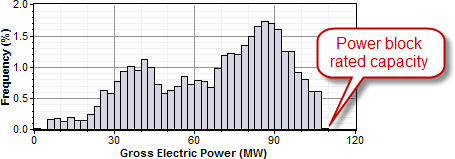
For example, consider a system with a power cycle design gross output rating of 111 MW and a solar multiple of one (SM=1) and no thermal storage. The following frequency distribution graph shows that the power cycle never generates electricity at its rated capacity, and generates less than 80% of its rated capacity for most of the time that it generates electricity:
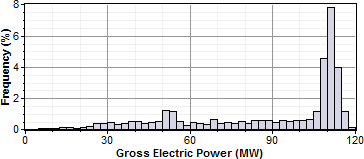
For the same system with a solar multiple chosen to minimize LCOE (in this example SM=1.5), the power cycle generates electricity at or slightly above its rated capacity almost 15% of the time:
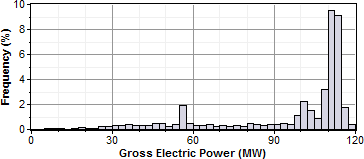
Adding thermal storage to the system changes the optimal solar multiple, and increases the amount of time that the power cycle operates at its rated capacity. In this example, the optimal storage capacity (full load hours of TES) is 3 hours with SM=1.75, and the power cycle operates at or over its rated capacity over 20% of the time:
Note
For clarity, the frequency distribution graphs above exclude nighttime hours when the gross power output is zero.
Reference Weather Conditions for Field Sizing#
The design weather conditions values are reference values that represent the solar resource at a given location for solar field sizing purposes. The field sizing equations require three reference condition variables:
Ambient temperature
Direct normal irradiance (DNI)
Wind velocity
The values are necessary to establish the relationship between the field aperture area and power cycle rated capacity for solar multiple (SM) calculations.
Note
The design values are different from the data in the weather file. SAM uses the design values to size the solar field before running a simulation. During the simulation, SAM uses data from the weather file you choose on the Location and Resource page.
The reference ambient temperature and reference wind velocity variables are used to calculate the design heat losses, and do not have a significant effect on the solar field sizing calculations. Reasonable values for those two variables are the average annual measured ambient temperature and wind velocity at the project location. For the physical trough model, the reference temperature and wind speed values are hard-coded and cannot be changed. The linear Fresnel and generic solar system models allow you to specify the reference ambient temperature value, but not the wind speed. The empirical trough model allows you to specify both the reference ambient temperature and wind speed values.
The reference direct normal irradiance (DNI) value, on the other hand, does have a significant impact on the solar field size calculations. For example, a system with reference conditions of 25°C, 950 W/m:sup:2, and 5 m/s (ambient temperature, DNI, and wind speed, respectively), a solar multiple of 2, and a 100 MWe power cycle, requires a solar field area of 871,940 m2. The same system with reference DNI of 800 W/m2 requires a solar field area of 1,055,350 m2.
In general, the reference DNI value should be close to the maximum actual DNI on the field expected for the location. For systems with horizontal collectors and a field azimuth angle of zero in the Mohave Desert of the United States, we suggest a design irradiance value of 950 W/m2. For southern Spain, a value of 800 W/m2 is reasonable for similar systems. However, for best results, you should choose a value for your specific location using one of the methods described below.
Linear collectors (parabolic trough and linear Fresnel) typically track the sun by rotating on a single axis, which means that the direct solar radiation rarely (if ever) strikes the collector aperture at a normal angle. Consequently, the DNI incident on the solar field in any given hour will always be less than the DNI value in the resource data for that hour. The cosine-adjusted DNI value that SAM reports in simulation results is a measure of the incident DNI.
Using too low of a reference DNI value results in excessive “dumped” energy: Over the period of one year, the actual DNI from the weather data is frequently greater than the reference value. Therefore, the solar field sized for the low reference DNI value often produces more energy than required by the power cycle, and excess thermal energy is either dumped or put into storage. On the other hand, using too high of a reference DNI value results in an undersized solar field that produces sufficient thermal energy to drive the power cycle at its design point only during the few hours when the actual DNI is at or greater than the reference value.
To choose a reference DNI value:
Choose a weather file on the Location and Resource page.
For systems with storage, specify the storage capacity and maximum storage charge rate defined on the System Design page.
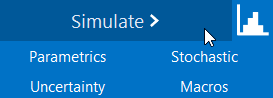
Click Simulate.
On the Results page, click Statistics.
Read the maximum annual value of Field collector DNI-cosine product (W/m2), and use this value for the reference DNI.
An alternative method is to choose a reference DNI value on the System Design page to minimize collector defocusing, to do this, try different values for Design point DNI on the System Design page until you find a value that minimizes the total Field fraction of focused SCAs output variable on the Statistics tab. You could also use parametric simulations to find the reference DNI value.